Friday, January 24, 2025
President Trump Gives Virtual Remarks to World Economic Forum

Saturday, March 31, 2018
Oblate Spheroid? - Got A Flat Earth Explanation Right Here Via Aqua-Optics
 |
| Flat Earth ... it's still a thing. Image Credit: Gizmodo Australia |
Oblate Spheroid? - Got A Flat Earth Explanation Right Here Via Aqua-Optics
The Earth isn't flat, or so we are told.
We have gone through many explanations on what the shape of the Earth actually is.
First, we were told the Earth is flat and that the water just simply dropped off of the edge into space. We all knew there were many problems with this explanation because it never dealt with the issue of the continued volume of water ... save for a recirculating pump that had not been yet invented.
Second, we were told the the Earth was spherical as in a basketball. Equal roundness from all sides. This explanation was bolstered through the exploits of explorers, Italy's Columbus, backed by Spanish money, being the chief among them in the search for a faster way to trade in India and China.
Last, satellites confirm that the actual shape of the Earth is more of that like someone sitting on a beach ball where the top to the bottom are closer to each other than from side to side. The technical name for this shape is Oblate Spheroid where it actually places that point that is closest to the heavens and stars as being around the Equator as opposed to being the recognized tallest mountain in the world, Mt. Everest.
This video has another idea ...
So, the Earth may be flat and that we are all suffering a case of optical illusion. It's an oddball planet we all are passengers on, especially when humans attempt to distort provable reality through entertaining narratives.
[ht: Justin Nuyens]
TAGS: Earth, Edmund Jenks, Mount Chimborazo, Oblate Spheroid, Tallest Point, Flat Earth, Water Distortion
Monday, June 20, 2016
Olli - Olly Oxen Free Autonomy Hits The Streets
 |
| I'm symbolic. Image Credit: Local Motors (2016) |
Olli - Olly Oxen Free Autonomy Hits The Streets
Local Motors, in partnership with computer giant IBM through Watson, introduces an organic small group/mass autonomous transportation solution perfect for most any community.
No oxen were used in this creation - Actually, "Olly Olly Oxen Free" is a catchphrase used in such children's games as hide and seek, capture the flag, or kick the can to indicate that players who are hiding can come out into the open without losing the game, that the position of the sides in a game has changed, or, alternatively, that the game is entirely over (ht: Wikipedia).
In this case the Olli is the name given to a driverless/autonomous vehicle that seats 12 people which through its computer partner, IBM's Watson, can interact with passengers and navigate the streets and deliver the people riding inside to their destination.
The game of driverless/autonomous vehicles has changed with the Olli concept because this application does not currently partner with a software services company like Google or Yahoo that are focused on individual transportation pods thus removing any pursuit of happiness from the process of actual driving.
This excerpted and edited from Electric Cars Report -
Local Motors Debuts First Self-driving Vehicle to Tap the Power of IBM Watson IoT
Local Motors, the creator of the world’s first 3D-printed cars, today introduced the first self-driving vehicle to integrate the advanced cognitive computing capabilities of IBM Watson.
The vehicle, dubbed ‘Olli,’ was unveiled during the grand opening of a new Local Motors facility in National Harbor, MD, and transported Local Motors CEO and co-founder John B. Rogers, Jr. along with vehicle designer Edgar Sarmiento from the Local Motors co-creation community into the new facility.
 |
| Olli exterior. Image Credit: Local Motors (2016) |
The electric vehicle, which can carry up to 12 people, is equipped with some of the world’s most advanced vehicle technology, including IBM Watson Internet of Things (IoT) for Automotive, to improve the passenger experience and allow natural interaction with the vehicle.
Olli is the first vehicle to utilize the cloud-based cognitive computing capability of IBM Watson IoT to analyze and learn from high volumes of transportation data, produced by more than 30 sensors embedded throughout the vehicle.
----
Furthermore, the platform leverages four Watson developer APIs — Speech to Text, Natural Language Classifier, Entity Extraction and Text to Speech — to enable seamless interactions between the vehicle and passengers.
 |
| Olli interior. Image Credit: Local Motors (2016) |
Passengers will be able to interact conversationally with Olli while traveling from point A to point B, discussing topics about how the vehicle works, where they are going, and why Olli is making specific driving decisions. Watson empowers Olli to understand and respond to passengers’ questions as they enter the vehicle, including about destinations (“Olli, can you take me downtown?”) or specific vehicle functions (“how does this feature work?” or even “are we there yet?”).
Passengers can also ask for recommendations on local destinations such as popular restaurants or historical sites based on analysis of personal preferences.
----
 |
| It's a beautiful Father's Day in #NationalHarbor! Catch up with CEO @johnbrogers & #meetolli- our latest innovation. Image Credit: Local Motors via @localmotors |
As part of Olli’s debut, Local Motors officially opened its new National Harbor facility in Maryland to serve as a public place where co-creation can flourish and vehicle technologies can rapidly advance. The company’s 3D-printed cars are on display, along with a large-scale 3D printer and an interactive co-creative experience that showcases what the future of the nation’s capital might look like.
----
Olli features a 15 kWh battery pack powering a 20 kW continuous, 30 kW max electric motor that delivers 125 N·m of torque. Maximum speed is 20 km/h (12 mph) and all-electric range is 58 km (32.4 miles). Olli is equipped with 2 Velodyne VLP16 LiDAR units, 2 IBEO ScaLa laser scanners, 2 ZED optical cameras and an Ellipse N GPS.
The very first Olli will remain in National Harbor this summer, and the public will be able to interact with it during select times over the next several months.
[Reference Here]
Now, riding around on this Oblate Spheroid, we say "Olli Olli Oxen Free" - to indicate that players who are hiding can come out into the open without losing the game, that the position of the sides in a game has changed, or, alternatively, that the game is entirely over - community driverless/autonomous transportation has arrived with a form factor and application that allows everyone the pursuit of happiness while pushing the technology envelope of possibilities forward.
TAGS: Local Motors, Watson, Cloud Computing, Internet of Things, IoT, driverless, autonomous, vehicle, Olli, 3D-printed cars, 3D printer, electric motor, ZED optical camera, Ellipse N GPS, Speech to Text, Natural Language Classifier, Entity Extraction, Text to Speech, National Harbor, Maryland
Monday, July 13, 2015
Waving Wind Sticks Can Replace Windmills
 |
| Sticks planted in the ground get moved by the wind where the movement is captured and converted to electricity. Image Credit: Vortex Bladeless (2015) |
Waving Wind Sticks Can Replace Windmills
There is a new wind energy capture technology in town and it deserves a serious look. The form factor is a stick that is effected by the wind as was the Tacoma Bridge on November 7, 1940.
Most people are familiar with a technology that was popularized by the Dutch in recent centuries which was used to move water from or around land and perform many labor tasks in their culture ... and has become the iconic symbol of all things Dutch - the Windmill. Of the 10,000 windmills in use in the Netherlands around 1850, about 1000 are still standing.
 |
| The total number of wind-powered mills in Europe is estimated to have been around 200,000 at its peak, which is modest compared to some 500,000 waterwheels. Image Credit: Zingrate.com |
Capturing the power of the wind through blades and transferring the motion created through a bar shaft to pump mechanisms, generators, or grinders, that once required human effort, to have the benefit of function.
Growing interest in alternative energy sources has made the three-pronged metal and composite wind turbines planted across open, wind-driven landscapes, a familiar sight.
 |
| Electric power windmills have been a feature in the Palm Springs entrance to Coachella Valley for at least 20 years. Image Credit: Edmund Jenks (2011) |
There is a company in Spain that wishes to have this display become less noisy, labor intensive, and cluttered through grabbing the wind energy through vibration or oscillation of a single stick.
This excerpted and edited from Quartz -
HOWLIN' - This wind turbine generates power without blades
By Zach Wener-Fligner for Quartz - May 19, 2015
Thanks to a Spanish energy startup known as Vortex Bladeless, there’s a new type of turbine with a rather different look.
With the potential to be cheaper and more reliable. Vortex’s generator resembles a giant straw in the ground and harnesses wind energy without the need for rotating windmill blades. It’s designed to vibrate in the wind as much as possible, like a guitar string; those vibrations are then converted into stored energy.
According to the company’s website, the Vortex turbines are 53% cheaper to manufacture and 51% cheaper to operate than traditional wind turbines. This is in part due to their lack of moving parts—there just aren’t that many components to break. Their current model, the 41-foot Vortex Mini tube, captures around 30% less energy than a traditional wind turbine, but can also be packed more densely into a given space.
The company has raised about $1 million from the Spanish government and private investors, according to Wired; it says it will begin raising more money via crowdfunding on June 1.
[Reference Here]
Windmills and solar panel farms are popping up everywhere creating an aesthetic eyesore, backed through the infusion of public monies. It is time to consider a cheaper, quieter, and more artful way to capture alternative (to petroleum) energy to fuel our lives.
Most like the concept of converting the lessons learned through the Tacoma Narrows Bridge disaster to achieve artful display landscapes, here on this Oblate Spheroid, that deliver on the promise of a better way to convert wind to energy for the good of all.
TAGS: windmills, solar panels, Tacoma Bridge, oscillation, wind stick, Vortex Bladeless, turbines, electricity, power generation, Oblate Spheroid, crowd-funding,
Tuesday, May 26, 2015
Anywhere Grid-Less Hosteling For One With Ecocapsule
 |
| Ecocapsule is smart house powered purely by the solar and wind energy. It allows people to reach the frontiers with the luxury of the hotel room. It can serve as micro-house, cottage, pop-up hotel or even as charging station for electromobiles. Image Credit: Nice Architects |
Anywhere Grid-Less Hosteling For One With Ecocapsule
Ever wonder how hard it would be to live in a space without access to electricity wires from a pole, or water from a pipe, supplied by a societal utility - and further, once achieved, hard hard it would be to replicate the solution?
A group of folks located in the Slovak Republic known as Nice Architects have created an egg shaped living space that hopes to make a living off-the-grid "audience-of-one" a reality and it goes by the name of Ecocapsule.
 |
| A 2D top-down view schematic of the Ecocapsule's living space floorplan. Image Credit: Nice Architects |
This egg-shaped living space is set to be debuted in Vienna, Austria this month (May 28 & 29, 2015) at a start up show that began in 2012 and has become what Forbes magazine calls "a smarter SXSW (Austin, TX)", the Pioneers Festival.
 |
| First functional prototype of the independent micro-house Ecocapsule will be exhibited in the foyer of the Hofburg palace as a part of Pioneers festival 2015 event in Vienna. Image Credit: Nice Architects |
Each unit is equipped with solar panels, a retractable wind-turbine, and a design that captures rain water.
 |
| Solor and wind power conversion included. The egg shape enhances water capture from dew or rain which is stored in a tank located underneath the floor and pumped for use in the sink, toilet, or shower. Image Credit: Nice Architects |
Inside, the design includes a kitchenette with running water, a flushing toilet, and hot shower.
 |
| Interior view from the storage end of the Ecocapsule. One has a hands on environment where one can sleep, cook, shower, deal with personal waste & cleanliness, and have little worry about power assisting in maintaining basic living needs. Image Credit: Nice Architects |
The Ecocapsule is suitable for a wide range of human-living applications. Suggestions by Nice Architects include independent research station, a tourist lodge, emergency housing, a humanitarian-action unit ... or as we might suggest at Oblate Spheroid, a personal/office space to be placed in the backyard which eliminates the cost and time consumed complying for the need of permits required by the local government offices.
 |
| Urban elbow room without the hassles associated with dealing with permitting. Image Credit: Nice Architects |
Place the Ecocapsule on a flatbed trailer, and now one has an actual trailer for grid-less, energy assisted, hosteled comfort for almost any application including ... just camping.
 |
| Exterior view shows external and interior storage plus bed. Image Credit: Nice Architects |
Those interested in buying one will be able to pre-order at the end of 2015, with delivery in the first half of 2016.
FAQ Section
What is the price of the Ecocapsule?
Price of the Ecocapsule will be announced in the last quarter of the 2015.
When will be Ecocapsule available for purchase?
We will start taking pre-orders in the last quarter of the 2015. We expect to start delivering first produced units in the first half of the 2016.
Shipping price - Ecocapsule can fit info standard shipping container, keeping shipping cost low. Here are examples of approximate shipping fees:
Slovakia -New York 2393 USD 2200 Euro
Slovakia-Buenos Aires 1958 USD 1800 Euro
Slovakia-Johannesburg 2937 USD 2700 Euro
Slovakia - Melbourne 1631 USD 1500 Euro
Camper version - We are still developing chassis for the capsule and hopefully we will be ready in late 2016.
Custom versions:
We will be initially offering one version of the Ecocapsule. Later we will extend customization options.
Where can we see it?
First public display of the Ecocapsule will be during Pioneers festival in Vienna (28-29th May 2015).
Later it will be displayed in Slovak national pavilion at Expo 2015.
Basic Specifications:
(ht: Nice Architects)
Dimensions:
W - 8.366 Feet - 2.55m
L - 14.599 Feet - 4.45m
H - 7.381 Feet - 2.25m or 14.763 Feet - 4.5m with extended pole
Weight: 3307 lbs. - 1500kg
Installed power output: wind 750W / solar 600W
Battery capacity: 9744Wh
TAGS: Ecocapsule, Pioneers Festival, SXSW, Forbes, Slovak Republic, Nice Architects, Vienna, Austria,
Wednesday, January 1, 2014
Happy New Year 2014 - Fireworks Display Via GIF
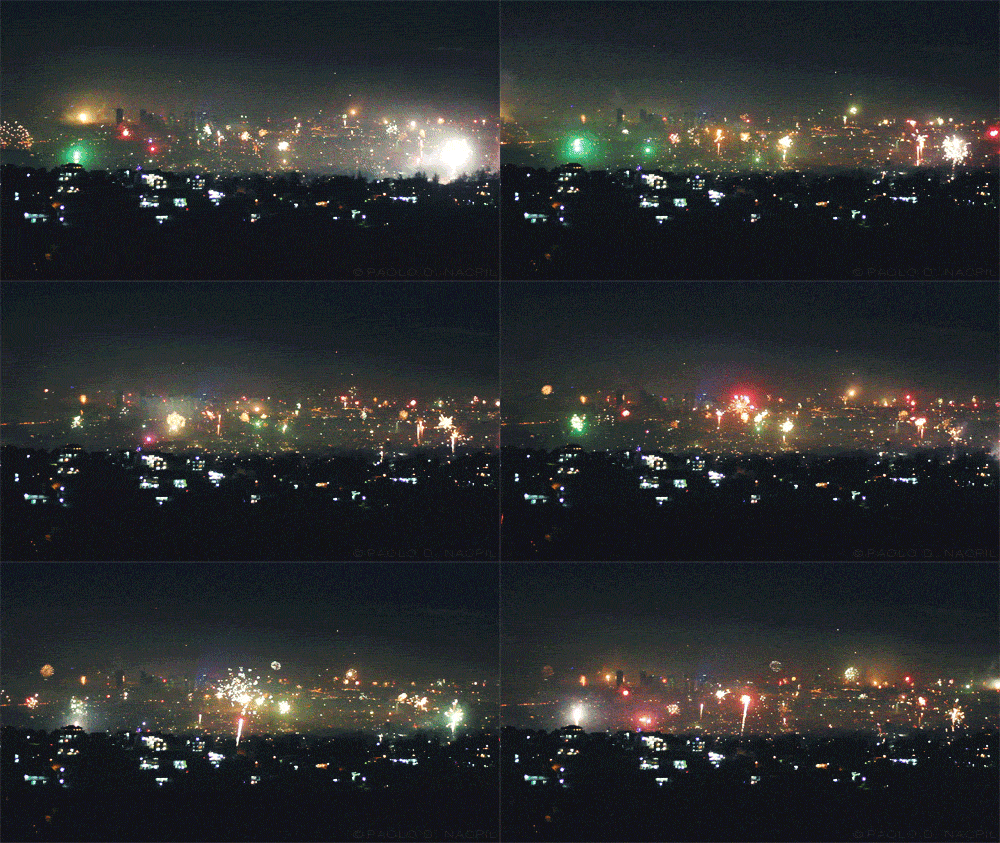 |
| New Year in the Philippines - The view of the Metro Manila skyline from Monterey Hills in San Mateo, Rizal. Credit: Paolo Nacpil via 24.media.tumblr.com |
Happy New Year 2014 - Fireworks Display Via GIF
 |
| Fireworks at the end of a rope. Credit: musicsongz.com |
 |
| Simultaneous color bursts all in one line. Credit: 9to5gifs.com |
 |
| Random explosions in light blue-white. Credit: media.tumblr.com |
 |
| Single red, white, and blue spherical burst. Credit: twodelighted.com |
 |
| Cityscape fireworks at waters edge. Credit: 24.media.tumblr.com |
 |
| Random spray burst fireworks at waters edge. Credit: f.ptcdn.info |
 |
| Single rocket multiple burst cascade firework. Credit: gifs.gifbin.com |
 |
| Eiffel Tower with superimposed white burst 'twilight sky' effect over Paris display. Credit: announcingit.com |
Have a Happy and Abundant 2014 here on this Oblate Spheroid shaped blue orb!
Friday, September 27, 2013
Popular Science Settles On Consensus Over Reporting Fact
 |
| Popular Science magazine cover that has as an article, "How to Prevent America's Next TRAIN CRASH" - funny, how now Popular Science is about trying to prevent the crash in the flow of America's research funding through shutting off comments that expose fraud. Image Credit: m5.paperblog.com |
Popular Science Settles On Consensus Over Reporting Truth Based In Facts
This week saw an actual sea change and weak stomach for debate on consensus over publishing comments that argue for scientific method derived facts and the truth.
This excerpted and edited from PopularScience.com -
Why We're Shutting Off Our Comments
By Suzanne LaBarre - Posted 09.24.2013 at 8:15 am
Starting today, PopularScience.com will no longer accept comments on new articles. Here's why.
Comments can be bad for science. That's why, here at PopularScience.com, we're shutting them off.
----
Another, similarly designed study found that just firmly worded (but not uncivil) disagreements between commenters impacted readers' perception of science.
If you carry out those results to their logical end--commenters shape public opinion; public opinion shapes public policy; public policy shapes how and whether and what research gets funded--you start to see why we feel compelled to hit the "off" switch.
A politically motivated, decades-long war on expertise has eroded the popular consensus on a wide variety of scientifically validated topics. Everything, from evolution to the origins of climate change, is mistakenly up for grabs again. Scientific certainty is just another thing for two people to "debate" on television. And because comments sections tend to be a grotesque reflection of the media culture surrounding them, the cynical work of undermining bedrock scientific doctrine is now being done beneath our own stories, within a website devoted to championing science.
[Reference Here]
 |
| "How It Works" - Credit: Popular Science |
popular consensus on a wide variety of scientifically validated topics
This is what Popular Science, the magazine and website, bases all of it opinion and articles on ... popular consensus. The fact that Popular Science is shutting down comments to their consensus derived articles proves that they admit to publishing Consensus over Scientific Method derived facts.
Since WHEN is Consensus a substitute for Scientific Method?
Not once is Scientific Method mentioned as the basis of information their articles are based upon. Their statement only alludes to popular consensus and scientifically validated topics.
Further, the editors admit to trying to shape public opinion through their publishing silo with this observation - "commenters shape public opinion; public opinion shapes public policy; public policy shapes how and whether and what research gets funded--you start to see why we feel compelled to hit the "off" switch." - and therein lays the rub.
Who holds the scientific community's feet to the fire when mathematical formulas and data are shaped so that results reflect the intent of the politically-motivated public policy. Follow the money.
The biggest problem with Popular Science is that the editors are nothing more than Progressive-Minded J-School Stenographers who report what has been bought-and-paid-for Consensus objectives, rooted in politically-motivated public policy, as opposed to reporting Scientific Method derived FACTS!!!
Does the mathematical fraud perpetrated by the University of East Anglia ever get reported and calculated into the Consensus equation? At Popular Science, now that they have hit the "off" switch on comments to their published articles - we, at Oblate Spheroid, think not!
Tuesday, January 29, 2013
Umbrella Public Relations Stunt Achieves World Record Claim

Umbrella Public Relations Stunt Achieves World Record Claim
Yesterday, at what has been billed as the world’s largest golf facility, Mission Hills Shenzhen, China, people holding umbrellas on the fairway of a picturesque golf link, claimed a world record by creating a “human” displayed QR Code.

The QR Code was formed by nearly 2,000 staff carrying umbrellas and an aerial photograph was taken from a height of 270 feet so that the code could be used in Press Releases.
The purpose of this PR effort is designed to promote sustainable eco-tourism ... and in celebration of Mission Hills' 20th anniversary, the Group is giving away twenty 3 day / 2 night Romantic Premier Spa Suite Getaway packages at Mission Hills Haikou Resort on the tropical island of Hainan.
When users scan the QR Code, they will be directed to a campaign website to answer three simple questions related to sustainable eco-tourism. Those who complete the questions with the correct answers will be entered into the draw for a chance to win one of the Mission Hills Micro Holiday packages valued at US$2,600.
(ht: PR Newswire)


This is not the first time people holding umbrellas stand in a predetermined pattern in order to form a QR Code upon which folks with camera/QR enabled smart phones could scan the code created and be directed to a website to qualify or buy something of value or interest. At the beginning of December last year, 1369 people raised black, white and blue umbrellas to form a QR Code directing people to a website that promotes Taiwan culture and tourism - http://www.taiwansayhi.com.
(ht: 2d)
** Article first published as Umbrella Public Relations Stunt Achieves World Record Claim on Technorati **
Thursday, June 14, 2012
City Block Size Asteroid Comes Near-Earth To Oblate Spheroid

City Block Size Asteroid Comes Near-Earth To Oblate Spheroid
An asteroid the size of a city block discovered by astronomers in Canberra will zoom past Earth but poses no risk of a collision.
The "unusually large" asteroid will not be visible to the naked eye but asteroid enthusiasts may watch it pass by during a live online broadcast, said Patrick Paolucci, president of the skywatchers' site, Slooh.
NASA has already cataloged 9000 such Near-Earth Objects, but astronomers are always on the lookout for new ones.
"Once in awhile one will come out of nowhere like this one, which is actually pretty big," Paolucci told AFP.
"We were like, 'Wow, we should track this one."'
The asteroid, named 2012 LZ1, is thought to be about 500 metres wide, and is expected to pass within 14 times the Moon's distance from the Earth.
The massive object was discovered just days ago by Scottish-Australian astronomer Rob McNaught and colleagues at the Research School of Astronomy and Astrophysics of the Australian National University.
The asteroid qualifies as a Near-Earth Object because of its size and proximity - more than 152 metres wide and within a distance of 7.5 million kilometres from Earth.
Paolucci said the asteroid's fly-by would be covered in real-time with footage from an observatory in the Canary Islands at Slooh.com beginning at 10am (AEST) on Friday.
[Reference Here]
Saturday, January 14, 2012
Hubble Captures Oldest On Record Galaxy - 13.1 Billion Light Years Away
 Image Credit: NASA
Hubble Captures Oldest On Record Galaxy - 13.1 Billion Light Years Away
NASA Hubble Space Telescope has captured an image of the oldest galaxy on record, the space administration announced January 10, 2012.
The space administration said it has captured an image of a group of galaxies located 13.1 billion light years away. The team said the galaxies represent a cluster in the initial stages of development.
The space administration notes that galaxy clusters are among the largest structures in the universe, comprising hundreds to thousands of galaxies bound together by gravity. The developing cluster, or protocluster, is seen as it looked over 13 billion years ago.
“These galaxies formed during the earliest stages of galaxy assembly, when galaxies had just started to cluster together,” said Michele Trenti of the University of Colorado at Boulder and the Institute of Astronomy at the University of Cambridge in the U.K. “The result confirms our theoretical understanding of the buildup of galaxy clusters. And, Hubble is just powerful enough to find the first examples of them at this distance.”
Hubble spotted the five galaxies while performing a random sky survey in near-infrared light. The newly found galaxies are small, ranging from 10 percent to 50 percent the size of our own Milky Way. But they are similar in brightness to the Milky Way, said astronomers NASA says the galaxy has likely grown into one of today’s massive “galactic cities,” comparable to the nearby Virgo cluster of more than 2,000 galaxies.
This excerpted and edited from NASA -
The Age of the Universe ... Then vs. Now
Before 1999, astronomers had estimated that the age of the universe at between 7 to 20 billion years. With advances in technology and the development of new techniques we now know the age of the universe is 13.7 billion years, with an uncertainty of only 200 million years. So how did this understanding come to be?
Early estimates of the Age of the Universe
In the 1920's Edwin Hubble discovered the expansion of the universe. He found that galaxies which are further away are moving at a higher speed following the law, v=Hod, where v is the velocity in km/s, d is the distance in Mpc, and Ho is the Hubble constant in km/s/Mpc. By independently measuring the velocity and distances to galaxies, the value of Ho could be determined. Astronomers further determined that the age of the universe is related to Hubble's constant, and that it is between 1/Ho and 2/3Ho depending on cosmological models adopted. The velocity could be determined via the redshift in the spectrum. The distance to the galaxy can be determined using observations of certain types of pulsating stars, called Cepheids, whose instrinsic brightness is related to the period of their brightness variation. However, the accuracy of the distance measurement was hampered by how faint ground based telescopes could see. Up until the 1990's, the best estimates for Ho were between 50 km/s/Mpc and 90 km/s/Mpc, giving a range on the age of the universe between 7 and 20 billion years.
Enter the Hubble Space Telescope
So in 1993, the orbiting Hubble Space Telescope began a "key project" to obtain distances to the Cepheids in 18 galaxies. Astronomers were able to obtain for the first time more precise distances, and a more accurate value of Ho. In 1999 after several years of observations with HST astronomers were able to estimate Ho to be 71 km/s/Mpc within 10% uncertainty, one of the greatest achievements of modern astronomy. Extrapolating back to the Big Bang, that value of Ho implied an age between 9 and 14 billion years old.
[Reference Here]
Astronomers note that most galaxies in the universe reside in groups and clusters, and astronomers say discovering clusters in the early phases of construction has been a challenge due to the fact that they are rare, dim and widely scattered across the sky. The new find helps demonstrate that galaxies build up progressively over time, researchers said. It also provides further evidence for the hierarchical model of galaxy assembly.
The team of astronomers are scheduled to deliver the results of the findings Tuesday at the American Astronomical Society meeting in Austin, Texas. The study will also be published in an upcoming issue of The Astrophysical Journal.
“Records are always exciting, and this is the earliest and the most distant developing galaxy cluster that has ever been seen,” said Michael Shull, a member of the team who discovered the protocluster. “We have seen individual galaxies this old and far away, but we have not seen groups of them in the construction process before.”
(ht: The State Column)
Saturday, December 24, 2011
An American President's Christmas Message From America To All
An American President's Christmas Message From America To All
It may amaze one to ponder that only 30 years ago (December 23, 1981), a President of the United States felt it was his leadership duty to speak directly about the reason for the season and assure all, whether they believed in Christianity or not, that our country and its citizens were protected here as one, under "Faith and Freedom" ... regardless of belief or circumstance.
May God bless the memory of Ronald Reagan. A message as poignant and timeless in 1981 as it is here in 2011.
Merry Christmas to all, and to all a good night!
Friday, November 18, 2011
Matter/ Antimatter - Atom Smasher Makes New Discovery
 The LHCb team stands in front of their experiment, the LHCb detecor, at the Large Hadron Collider in Geneva. Image Credit: CERN/Maximilien Brice, Rachel Barbier
Matter/ Antimatter - Atom Smasher Makes New Discovery
An atom smasher based near Geneva, Switzerland conducted an experiment recently and found that there may be bits of matter that don't mirror the behavior of their antimatter counterparts.
This observance is unexpected, in that scientists have operated under the theory the universe started off with roughly equal amounts of matter and antimatter where particles of antimatter have the same mass of their twins but an opposite charge. They theorized that over the ensuing 14 billion years, most of the antimatter was destroyed, leaving a leftover universe of mainly matter.
After many experiments, in Switzerland, using the Large Hadron Collider, the 17-mile (27 km) circular particle accelerator, researchers are reporting that some matter particles produced inside the machine appear to be behaving differently from their antimatter counterparts, which might provide a partial explanation to the mystery of antimatter.
 Roughly equal amounts of matter and antimatter are created in the collision of energetic gold nuclei inside the particle accelerator dubbed RHIC, but because the fireball expands and cools quickly, antimatter can survive longer than that created in the big bang. In this collision an ordinary helium-4 nucleus (background) is matched by a nucleus of antihelium-4 (foreground). Image Credit: STAR Collaboration and Lawrence Berkeley National Laboratory
This excerpted and edited from LiveScience.com -
Is the New Physics Here? Atom Smashers Get an Antimatter Surprise
By lt | LiveScience.com
One potential explanation for this outcome is called "charge-parity violation." CP violation means that particles of opposite charge behave differently from one another.
The LHCb researchers found preliminary evidence that this is happening when particles called D-mesons, which contain "charmed quarks," decay into other particles. The whimsically named charmed quarks, like many exotic particles, are so unstable, they last only a fraction of a second. They quickly decay into other particles, and it is these products that the experiment detects. ("LHCb" is short for LHC-beauty, another flavor of quark.)
From the experiment, the researchers found a 0.8 percent difference in the probabilities that the matter and antimatter versions of these particles would decay into a particular end state.
----
The new finding ranks as a "3.5 sigma" result, meaning the statistics are solid enough that there is only a 0.05 percent likelihood that the pattern they see isn't really there. For something to count as a true discovery in particle physics, it must reach a 5 sigma level of confidence.
"It's certainly exciting, and certainly worth pursuing," LHCb researcher Matthew Charles of England's Oxford University told LiveScience. "At this point it's a tantalizing hint. It's evidence of something interesting going on, but we're keeping the champagne on ice, let's say."
----
If the finding is borne out, it would be a big deal, because it would mean the reigning theory of particle physics, called the Standard Model, is incomplete. Currently the Standard Model does allow for some minor CP violation, but not at the level of 0.8 percent. To explain these results, scientists would have to alter their theory or add some new physics to the existing picture.
----
One possible example of the kind of new physics that might explain such CP violation is called supersymmetry. This theory suggests that in addition to all the known particles, there are supersymmetric partner particles that differ by half a unit of spin. Spin is one of the fundamental characteristics of elementary particles.
So far, no one has found direct evidence of supersymmetry. But if supersymmetric particles exist, they might be created instantaneously and disappear again during the particle-decay process. That way they could interfere with the decay process, potentially explaining why matter and antimatter decay differently.
[Reference Here]
As the old saying goes ... the more man gains answers to questions, the more questions to be answered are raised here ... on this Oblate Spheroid.
<Article seen first as Matter / Antimatter - Atom Smasher Makes New Discovery at Technorati>
Tuesday, August 2, 2011
Twisting Buzz Lightyear ... "To Beyond, And Infinity"
 Using the infrared Herschel Space Observatory, Astronomers have discovered this ring of gas at the center of our Milky Way that looks like an infinity symbol - image annotated. The image was taken using two of Herschel's instruments -- the photodetector array camera and spectrometer (70-micron-light is coded blue; 160-micron light is coded green) and the spectral and photometric imaging receiver (350-micron light is red). Image Credit: ESA/NASA/JPL-Caltech
Twisting Buzz Lightyear ... "To Beyond, And Infinity"
In a strange twist of science, astronomers using the Herschel Space Observatory have discovered that a suspected ring at the center of our galaxy is warped for reasons they cannot explain. The above image reveals the ring with greater clarity than ever before. It can be seen as the yellow loop that appears to have two lobes, highlighted here with a white ribbon overlay. In fact, the ring, which is a collection of very dense and cold gas and dust, is twisted so that part of it rises above and below the plane of our Milky Way galaxy.
Astronomers aren't sure how rings like this form in galaxies but some theories suggest they arise out of gravitational disturbances with neighboring galaxies. New stars are thought to be forming in the dense gas making up the ring.
According to NASA's Jet Propulsion Laboratory (JPL) in Pasadena, Calif., astronomers were shocked by what they saw when they aimed the telescope at the galaxy's inner ring.
"[The] ring, which is in the plane of our galaxy, looked more like an infinity symbol with two lobes pointing to the side," JPL officials said in a statement. "In fact, they later determined the ring was torqued in the middle, so it only appears to have two lobes. To picture the structure, imagine holding a stiff, elliptical band and twisting the ends in opposite directions, so that one side comes up a bit."
Previous observations to date had only revealed portions of the ring. The Herschel Space Observatory, an infrared European Space Agency-led mission with important NASA contributions, sees long-wavelength infrared light, which can penetrate through the murky region at the center of our galaxy, allowing Herschel to get a more complete view.
"This is what is so exciting about launching a new space telescope like Herschel," said Sergio Molinari of the Institute of Space Physics in Rome, lead author of a new paper on the ring in the journal Astrophysical Journal Letters. "We have a new and exciting mystery on our hands, right at the center of our own galaxy."
The ring stretches across more than 300 light-years of space, and is about 15 Kelvin (that's minus 433 degrees Fahrenheit here on the Oblate Spheroid). The warmest material in this picture is blue, and the coldest is red.
The twist in the ring is not the only mystery to come out of the new Herschel observations. Astronomers say that the center of the torqued portion of the ring is not where the center of the galaxy is thought to be, but slightly offset. The center of our galaxy is considered to be around "Sagittarius A*," where a massive black hole lies. According to Alberto Noriega-Crespo of NASA's Infrared Processing and Analysis Center at the California Institute of Technology in Pasadena, it's not clear why the center of the ring doesn't match up with the assumed center of our galaxy. "There's still so much about our galaxy to discover," he said.
Oh, and the reference to Toy Story's Buzz Lightyear? ... Whenever he launched himself to be in flight, he would always exclaim, "To infinity, and beyond!" Little did the writers and creators of Toy Story know that there was actually a destination as ... Infinity.
An abstract and full PDF of the Astrophysical Journal Letters study is online at http://arxiv.org/abs/1105.5486.
(ht: herschel.caltech.edu & space.com)
[Article first published as Twisting Buzz Lightyear ... "To Beyond, And Infinity" on Technorati]
Friday, May 13, 2011
Google's Blogger Down For Over 24 Hours!
 Blogger Logo - Image Credit: Blogger.com
Google's Blogger Down For Over 24 Hours!
Blogger ... Google's web log hosting portal, has been down for a full 24 hours at the time of this posting.
This seems like a modern era record for this usually very reliable communications service and personal publishing arm of the giant search powerhouse, Google.
With all of the push Google has been putting in on Chrome, one has to ask - Is Blogger now becoming just an ugly stepchild to the array of focused services that Google has to offer? What - isn't Blogger sexy enough for Google to keep outages down to a minimum?
If this is the case, Google's shine is losing its luster.
This excerpted from Blogger's Status Link:

Push-Button Publishing
Blogger Status
Friday, May 13, 2011
Posted by at 06:07 PDT
Posted by at 04:25 PDT
----
UPDATE May 13, 2011 - 9:50am PT:
Blogger back online after nearly 30 hours of non-service.
Wednesday, December 1, 2010
The Circular Nature Of Homo Sapiens
The Circular Nature Of Homo Sapiens
Humans can't walk in a straight line. If there's no fixed point of reference, our species just walk in circles and inevitably … get lost. Nobody knows why, but researchers at the Max Planck Institute for Biological Cybernetics have confirmed this tendency in several experiments.
If one walks, drives or sails wearing a blindfolded, in the middle of a fog occurrence, or at night without stars in sight, a human will not be able to keep moving in a direction that would be a straight line. No matter how hard one tries, humans will end up going in a circular direction because, for some mysterious reason, humans always have the tendency to lean (and thereby move) toward one side more than the other.
Some people speculate that this is because one side of the brain is dominating the other one. While other people speculate that the reason may be purely mechanical reasoning (with their reasoning side of the brain) that one of our legs is always sightly shorter than the other. But, according to the results of the study, these are not the causes for this unique behavior. At least, there's not one single explanation and it may be a combination of many.
Whatever the reasons are, don't get placed into a dark forest blindfolded and without a compass – however … screw the GPS when navigating around this Oblate Spheroid.
Thursday, September 30, 2010
Earth 2.0 ... Life Possible On Gliese 581g, 20.5 Light-Years Away
 A planet, as depicted in this rendering, orbits the habitable zone of a star 20 light years from Earth, meaning it could have water on its surface. Image Credit: National Science Foundation and NASA
 Earth 2.0 ... Life Possible On Gliese 581g, 20.5 Light-Years Away
Astronomers at the Keck telescope in Hawaii, during a study that has been underway for more than a decade, have identified a solar system that has a planet they suspect could support life as we know or understand it here on our Oblate Spheroid.
Let's call it Earth 2.0. It is a planet that is circling a Sun named Gliese, that is located a little over twenty light years away (the time it would take to get there if one could travel in a craft at the speed of light and carry enough food and etc. to sustains one's life to arrive and observe this suspect orb on site).
 Carbon copy? The Gliese 581 solar system resembles our own but on a much smaller scale. Planet "G" is located in the "Goldilocks" zone of this sun's solar system [CTRL-CLICK photo to launch YouTube video]. Image Credit: Zina Deretsky/National Science Foundation
This excerpted and edited from All Voices news webportal -
Discovered Planet Zarmina (Gliese 581g) Is 'Habitable' For Human Life
By ryangeneral - Honolulu : HI : USA | Sep 30, 2010
The planet lies near the middle of the Goldilocks zone, or habitable zone of its parent star, and the presence of liquid water is considered a strong possibility. The discovery of Gliese 581 g was announced in September 2010, and is believed to be the first Goldilocks planet ever found, the most Earth-like planet, and the best exoplanet candidate with the potential for harboring life found to date.
The planet was detected using radial velocity measurements combining the data from the HIRES instrument of the Keck 1 telescope and the HARPS instrument of ESO's 3.6m telescope at La Silla Observatory. The planet is believed to have a mass of three to four times that of the Earth and an orbital period of just under 37 days.
Steven Vogt, the co-discoverer, unofficially named the planet "Zarmina", after his wife.
Reference Here>>
The Goldilocks zone refers to a story that parents read to their children that goes by the formal title "The Story Of The Three Bears". This fable, often referred to as "Goldilocks and the Three Bears" is a children's story first recorded in narrative form by English author and poet Robert Southey and first published in a volume of his writings in 1837. The same year, writer George Nicol published a version in rhyme based upon Southey's prose tale, with Southey approving the attempt to bring the story more exposure. Both versions tell of three bears and an old woman who trespasses upon their property.
(ht: wikipedia)
In the fable, Goldilocks is hungry and stumbles upon a home of Bears where three bowls of soup or porridge are on the table. Goldilocks helps herself to eating some of the porridge and discovers that one bowl of the food mixture is too hot, one is too cold, and one ... the one she presumably eats all up is ... Just Right!
This planet discovery is in a solar system zone that is just right given our knowledge of the origins of life as we know it here on Earth.
We wonder if the shape of this Gliese 581g orb is the same Oblate Spheroid shape of our own Earth. Welcome Zarmina ... welcome Earth 2.0.
Thursday, May 6, 2010
Of Neanderthals & Homosapiens - The Nanderthal In Most All Of Us
 The Neanderthal project, which took four years and involved 57 scientists, is the latest and most astonishing example of the recovery of scientifically useful information from ancient DNA. Image Credit: Sydney Morning Herald
Of Neanderthals & Homosapiens - The Nanderthal In Most All Of Us
When someone makes a simple mistake, some people call out the person making the mistake by saying, "You Neanderthal!" Growing up this was a typical degrading accusation heard along the way but as it turns out ... this statement might have held more truth than we even knew.
It has been discovered through studies with DNA genomes that interbreading between Neanderthals and Homosapiens did indeed take place and as a result, 1 to 4 percent of the genes carried by non-African people are traceable to the much-caricatured, belittled, and large-browed cavemen.
So now when one makes a mistake and gets accused of being a Neanderthal, if the person has Caucasian DNA, one has to ask ... are they the one, two, three, or four percent type of Neanderthal?
This excerpted and edited from All Headline News -
Study: Neanderthals Interbred With Homosapiens
Windsor Genova - AHN News News Writer - May 6, 2010 5:49 p.m. EST
The findings was the result of the comparison of the genomes of modern human and the burly and big-brained Neanderthal conducted by geneticist Svante Pääbo at the Max Planck Institute for Evolutionary Anthropology in Leipzig, Germany. The findings were published Thursday in the journal Science.
----
Neanderthal originated from Europe, Russia and the Middle East. They existed 400,000 to 30,000 years ago. Modern humans are said to have originated from Africa and the two species encountered each other in the Middle East and limited interbreeding occurred.
Pääbo constructed the Neanderthal genome using fossil DNA from three Neanderthal women who lived in Croatia between 38,000 and 45,000 years ago.
Reference Here>>
All this study really proves is that it's love ... that makes the Oblate Spheroid go around, you big lugg!
Thursday, April 1, 2010
Dew Drops Are Fallin' On My Head ...
 Stunning: Droplets of water bead on the head of this blue dragonfly as it slumbers on a leaf. Image Credit: Miroslaw Swietek
Dew Drops Are Fallin' On My Head ...
When someone mentions bugs ... flies, moths, dragonflies and the like, one congers up mental images of prickly, dirty, and somewhat mono-colored nuisances that have to be sprayed or flicked away in order for one not to be bothered while around them and in their element. They are not welcome in the house, or tent, and they definitely never exude any beauty!
The stunning micro-photography of Miroslaw Swietek from around the Polish countryside on this Oblate Spheroid might just be changing minds when they are lingered over and studied on every detail. Just beautiful.
This excerpted and edited from The Daily Mail -
Would dew believe it: The stunning pictures of sleeping insects covered in water droplets
By Daily Mail Reporter - Last updated at 11:29 AM on 31st March 2010
Glistening in the early morning, these insects look like creatures from another planet as dew gathers on their sleeping bodies.
Captured in extreme close-up, one moth appears to be totally encrusted in diamonds as it rests on a twig.
Dragonflies, flies and beetles also take on an unearthly quality as the water droplets form on them.
These remarkable photographs were taken by physiotherapist Miroslaw Swietek at around 3am in the forest next to his home.
Using a torch, the 37-year-old amateur photographer hunts out the motionless bugs in the darkness before setting up his camera and flash just millimetres from them.
 Close up: Amateur photographer Miroslaw Swietek captured this common fly slumbering on top of a plant as the water condenses on its body
 Bejewelled: This month looks like it has been encrusted in diamonds as it rests on a twig
Mr Swietek said: 'I took up photography as a relaxing hobby two and a half years ago and I particularly like taking pictures of insects and lizards.
'I photograph them in their natural environment in the forest next to my village.
'They all are covered in dew because I go to the forest in the morning at around 3am.
'At 3am to 4am insects are sleepy and taking photos of them is easy, but it is very difficult to find them.
 Close up: The insects appear to be completely drenched in water as they rest while the sun is down
 Shower time: Mr Swietek gets up at 3am to capture the insects while they are less active in a forest near his home
'You must be very fast taking the photos because the dew quickly disappears.
'It is very satisfying getting a good shot of an insect which I have had to hunt out.
'I have books which help my identify insects but because they are all covered in dew I find it almost impossible to know which types they are.'
Although insects do not 'sleep' in the same sense as humans, they enter a state of torpor where they are virtually immobile and much less sensitive to external stimuli.
Mr Swietek lives with his wife and teenage son in Jaroszow, a village in Poland around 30 miles from the city of Wroclaw.
 Clinging on: The amateur photographer searches for the insects using a torch and then sets up his camera and flash right next to them
 Hobby: Another dragonfly enjoys an early morning wash. Mr Swietek only took up photography two and a half years ago